Word Card Sort: Solitaire
- 4.9
- Rating
- 10.00K
- Installs
- Free
- Price

 Analysis by App-foxy
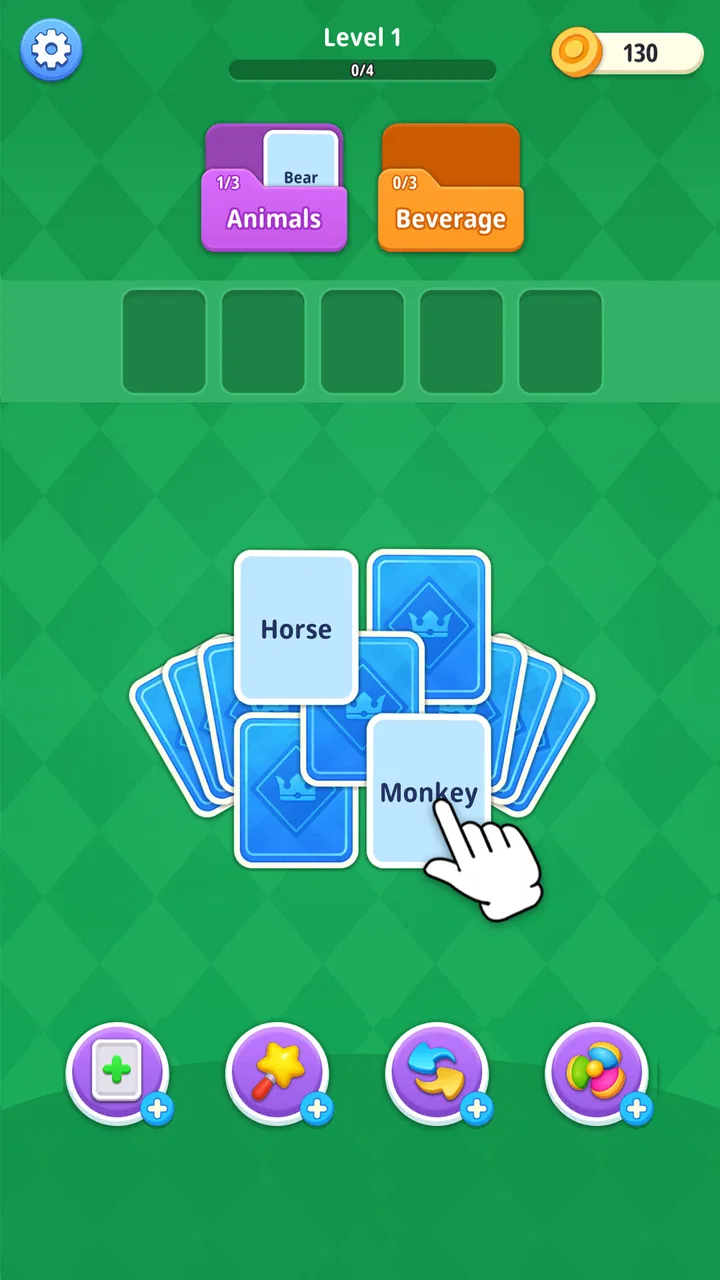
I approached Word Card Sort: Solitaire expecting a light word game, but its appeal is more specific than that. It combines word grouping with a card-solitaire presentation, so the challenge is not simply finding a definition or spelling a word correctly. I have to notice relationships, sort cards into sensible sets, and keep my attention on the board while deciding what belongs together. That makes it a thoughtful choice for short breaks rather than a game I play on autopilot.
It is a free word game from BitEpoch, rated for Everyone, and it runs on Android devices using version 6.0 or later. The current release is 1.130, and the game has passed the early discovery stage with over 10 thousand installs. Its average rating is 4.9 from around 320 ratings, which suggests that the central idea has connected well with the people who have tried it. I still think the best way to judge it is by the kind of thinking it encourages, and by how comfortable you are with its spending model.
How the card-sorting idea feels in everyday play
The basic pleasure comes from turning a messy collection of words into an organized result. A card may seem to fit several possibilities at first, and that uncertainty is where the game gets its value. I find myself testing a relationship, stepping back when it feels too obvious, and looking for a stronger connection elsewhere. The solitaire framing gives the activity a calm rhythm, while the word element keeps it from becoming a purely visual matching exercise.
You May Also Like

 Blood Strike: 2.5 Anniversary
Blood Strike’s Loadouts Turn Every Drop Into a Tactical Gamble
A close look at Blood Strike’s custom loadouts: how fast access to signature weapons reshapes its battle royale rhythm, rewards preparation, and narrows the gap between fights.

 Pandora - Music & Podcasts
Pandora’s Music Is Easy to Start, but Harder to Recover
Pandora’s strength is its low-effort path from a seed to a station. Its weak spot is how much confidence it asks you to place in connection, setup, and quiet recovery.

 8 Ball Pool
 Is Built on Rivalries, Rematches, and Routine
A close look at the rivalries, rematches, shared routines, and unanswered safety questions that turn a quick pool match into a persistent mobile community.

 Samsung Music
’s Quiet Strength Is Playing What You Already Own
Its reach comes less from spectacle than from dependable access to a personal library. That simplicity is both the app’s strongest retention engine and its ceiling.

 AccuWeather: Weather Radar
AccuWeather Review: A Quick, Clear Forecast for Everyday Decisions
For everyday plans, the best forecast is the one you can understand quickly. AccuWeather makes rain timing, radar, and local conditions easy to act on, with a few trade-offs.

 Hill Climb Racing
Why Hill Climb Racing Still Turns Crashes Into One More Run
A tiny car, a bumpy hill and one more upgrade: Hill Climb Racing keeps resurfacing because its simple chaos makes every near-miss feel personal.
More From Our News Desk
View All News


This is a good fit for someone who enjoys word puzzles but does not always want a crossword, a timed anagram, or a traditional spelling challenge. The difference matters. Crossword clues usually guide me toward one answer at a time, whereas card association asks me to compare several words and judge how they work as a group. That makes the experience feel closer to organizing ideas than filling blanks.
I also like that the concept works in small sessions. If I have a few quiet minutes while waiting for an appointment, I can focus on a board without needing to remember a long story or manage a complicated character system. The format is naturally suited to casual play, although people who prefer deep, uninterrupted puzzle sessions may eventually want more variety than a compact card-sort structure can provide.
What makes the word associations satisfying
The strongest moments arrive when a group becomes clear only after I stop looking at each card in isolation. A word can be connected by meaning, usage, or a broader theme, and the mental shift from “these seem related” to “these belong together” is rewarding. That small act of reclassification is more interesting than tapping identical symbols, because it asks me to explain the relationship to myself.
My practical advice is to avoid committing to the first plausible group. I first scan the entire board, identify the most distinctive words, and then reserve flexible cards until the less obvious relationships become clearer. This habit reduces careless choices and makes the game feel more like deduction than guessing. It is also a useful way to keep the difficulty manageable when several associations appear convincing.
Another helpful approach is to look for the word that would make a group too broad. If three cards seem linked by a general idea, I ask whether the fourth card has a more precise connection somewhere else. That extra check is important in a game built around association, because broad categories can be tempting while still being weaker than a narrower intended group.
Progress without turning every session into a race
Word Card Sort: Solitaire works best for me when I treat progress as a series of small reasoning exercises rather than as a test of speed. I can play carefully, reconsider a choice, and enjoy the discovery. That pace makes it suitable for people who want a relaxing brain workout, including players who like language games but dislike the pressure of a countdown.
There is still a natural sense of pressure whenever I am unsure whether a group is correct. Even without relying on fast reflexes, a questionable choice creates tension because one mistaken assumption can affect the rest of the board. I think that is a productive kind of pressure, provided you enjoy uncertainty. If you want a completely predictable, meditative card game, the word-association layer may feel more demanding than expected.
The game can also work as a gentle vocabulary exercise, though I would not treat it as a formal learning tool. It encourages me to think about meanings and categories, but it is primarily designed for play. Someone studying a language may enjoy the exposure to relationships between words, yet a dedicated vocabulary app would usually offer clearer lessons, pronunciation practice, and structured repetition.
Who will enjoy it, and who may want something else
I would recommend it to adults and younger players who enjoy sorting, wordplay, and quiet puzzle solving. The Everyone rating makes it approachable for a broad audience, but age suitability does not guarantee that every board will feel easy. A child may understand the rules quickly and still find some associations challenging, while an experienced word-game player may appreciate the need to reconsider seemingly obvious groups.
It is particularly suitable for players who like the familiar comfort of solitaire but want more mental involvement than arranging cards by suit or rank. The card presentation provides an accessible entry point, and the word logic gives each decision a reason. I can see it fitting into a daily routine as a short break after work, during a commute when playing is safe and practical, or as a low-noise alternative to scrolling through social feeds.
I would skip it if your main goal is competitive multiplayer, a long narrative campaign, or a highly strategic deck-building system. This is a focused word puzzle, not a substitute for a social card battler or a story-driven adventure. Players who need constant novelty may also prefer an app with several puzzle formats instead of one central sorting idea.
Spending, fairness, and what I would check before committing
The game is free to start, with in-app purchases ranging from $1.99 to $99.99 per item. That is the most important spending context for a new player: the entry cost is zero, but the available purchase range includes both small and substantially larger options. I would begin without buying anything, learn how the regular play loop feels, and only consider spending after deciding whether the game earns a place in my routine.
I am careful here because purchase information alone does not tell me what each item does. It does not establish whether a purchase removes interruptions, grants hints, accelerates progress, or changes access to content. I would not assume that spending is necessary, nor would I assume that every purchase is cosmetic or optional. The sensible approach is to read each item’s description at the moment of purchase and keep device-level purchase controls active, especially on a shared phone or tablet.
For a casual word game, fairness depends heavily on whether a player can enjoy the core sorting challenge without feeling pushed toward payment. From my perspective, the safest expectation is to judge the free experience first. If a board is difficult, I would try a slower scan and a different grouping strategy before treating a purchase as the solution. That keeps the decision connected to the puzzle itself rather than to frustration.
I also recommend setting a personal spending limit before experimenting with optional items. A small purchase can feel harmless when made in isolation, while repeated convenience purchases can change the cost of a supposedly free game. Because the available range reaches from a modest amount to a much larger one, families should be especially deliberate about who can authorize transactions.
Competitive fairness and the kind of player advantage that matters
This is not the sort of game I would choose to measure myself against a live opponent. Its meaningful competition is mainly personal: can I recognize stronger associations, avoid premature choices, and solve a board more thoughtfully? That makes fairness less about rankings and more about whether spending changes the puzzle-solving experience.
I would feel comfortable recommending it to someone who plays for concentration rather than status. There is no reason to approach every board as a public performance. The game’s value is in the mental process, and that means a careful player can enjoy it without needing the fastest possible result or the most expensive set of optional resources.
At the same time, anyone who wants transparent competitive rules should look for a game built specifically around head-to-head play. A solitaire-style word experience is better suited to private practice and self-improvement. Comparing scores with friends can still be fun if the game supports that naturally, but I would not select this title solely because I wanted an esports-like contest.
Small habits that improve the experience
My first useful habit is to separate certainty from possibility. I mentally mark a group as strong only when the connection is specific enough to explain in one sentence. If I need a vague justification, I leave those cards open and inspect the remaining options. This prevents one broad category from absorbing cards that belong to a more precise set.
My second habit is to change the order in which I inspect the board. Instead of repeatedly staring at the same four cards, I start with the least flexible word and work outward. Distinctive cards often reveal the theme of a group, while common words are easier to place after that theme becomes visible. This is a simple adjustment, but it makes difficult boards feel less random.
My third tip is to use the game as a deliberate reset between demanding tasks. I would not play it while trying to multitask, because the associations deserve actual attention. Five focused minutes are more satisfying than ten distracted minutes in which I tap through guesses. The game is casual in presentation, but its best moments come from giving the puzzle enough mental space.
For families, I would turn a board into a conversation rather than handing over the answer. Asking why two words belong together encourages reasoning and makes the activity more social without requiring a competitive mode. For an individual player, noting the reason a group works can help build a repeatable solving method and reduce reliance on trial and error.
What I would want to know before downloading
The most practical question is whether it works on an older device. Android 6.0 is the minimum operating system, so the compatibility requirement is relatively broad for people keeping an older phone in service. I would still check available storage and general device performance before installing any game, but the stated system requirement should not exclude many basic Android devices.
Another common question is whether the game suits a short session. In my experience of the format, yes: the card-sorting concept is easy to understand quickly, and a player can focus on one puzzle without committing to a long campaign. That does not mean every session will feel equally brief. A difficult board can hold my attention longer because I want to resolve the final uncertain relationship.
People also often ask whether a high rating guarantees a perfect experience. It does not. The game’s 4.9 average from around 320 ratings is encouraging, but ratings reflect the experiences of a particular group of players. Someone who dislikes word association may not enjoy it even if many others do. I would treat the rating as a positive signal, not as a replacement for matching the game to my own preferences.
The developer is BitEpoch, and the current version is 1.130. Those details are useful when checking that the installed listing matches the version I intend to try. I would also review the purchase screen carefully before confirming anything, since the free download and the optional spending range are separate parts of the decision.
Where it stands beside familiar word-game alternatives
Compared with a crossword, this game asks for broader grouping decisions and less clue-by-clue filling. That makes it easier to start when I do not want to solve a large grid, but it may feel less satisfying if I enjoy long-form clue chains and a finished puzzle that records every answer. Compared with anagram games, it places less emphasis on rearranging letters and more on recognizing meaning.
Compared with ordinary solitaire, the card layout is only the surface layer. The real challenge is language and categorization, so players seeking a purely relaxing card routine may find it more mentally active. Compared with a vocabulary trainer, it is more playful and less structured. I would choose it for flexible entertainment, not for a measurable study plan.
That positioning is its main strength and its main limitation. The focused design gives the game a clear identity, but it also means the experience depends on whether word association is the kind of challenge I want today. When I want a calm puzzle with enough friction to keep my mind engaged, it fits well. When I want social play, narrative progression, or formal learning, another category is likely the better choice.
My trust verdict
I come away viewing Word Card Sort: Solitaire as a pleasant, specific puzzle rather than a universal recommendation. Its card-based word grouping gives solitaire fans a more thoughtful alternative and gives word-game players a softer entry point than a demanding crossword. The strongest reason to try it is the quality of the decisions: the game asks me to compare relationships, resist easy assumptions, and find a coherent structure in a scattered set of cards.
I would install it for quiet breaks, family wordplay, or a short mental reset, especially if I enjoy puzzles without timers or story obligations. I would not install it expecting multiplayer competition, formal language instruction, or an endlessly varied collection of game types. Those expectations would point toward other apps.
The free starting point makes testing straightforward, but I would keep spending deliberate because individual purchases run from $1.99 to $99.99. My recommendation is to play first, understand how the progression feels, and inspect every purchase description before paying. The fair choice is to decide based on the free puzzle experience, not on pressure created by uncertainty.
Overall, BitEpoch has built a word game with a clear personality: calm on the outside, analytical underneath. The broad Everyone rating, strong player response, and accessible Android requirement make it easy to consider, while the optional purchase range is a reason to stay attentive. If sorting words into meaningful groups sounds more appealing than racing against a clock, I think this is worth trying.
FAQs for Word Card Sort: Solitaire
01What is Word Card Sort: Solitaire, and how is it played?
Word Card Sort: Solitaire combines classic solitaire-style card organization with word-based sorting challenges. Instead of only arranging cards by suit or number, you typically need to identify, group, or organize cards according to letters, words, or related categories. The gameplay is designed to be easy to understand, but later levels can require careful planning, quick recognition, and strategic moves to avoid blocking useful cards.
02Is Word Card Sort: Solitaire free to download and play?
The game can generally be downloaded and played without an upfront purchase, although the exact availability of free content may depend on the version and platform. Like many casual puzzle and solitaire games, it may include optional advertisements, in-app purchases, or paid items such as hints, extra moves, or ad removal. Check the store listing before installing to confirm current pricing and purchase details.
03Does Word Card Sort: Solitaire require an internet connection?
Many basic solitaire and word-sorting levels may be playable without a continuous internet connection, which makes the game convenient for travel or short offline sessions. However, features such as advertisements, cloud synchronization, leaderboards, daily challenges, rewards, or purchases may require access to the internet. Offline behavior can vary between Android and iOS versions, so test the game after installation if offline play is important to you.
04Is Word Card Sort: Solitaire suitable for children and beginners?
The game is generally approachable for beginners because its card-based controls and sorting objectives are easy to learn through practice. It may also support vocabulary recognition and light logical thinking, depending on the level design. Parents should still review the age rating, advertising content, language difficulty, and in-app purchase settings, since these details can change with updates and may differ between the Android and iOS editions.
05Are there hints, rewards, or difficulty increases in Word Card Sort: Solitaire?
Word Card Sort: Solitaire is designed to provide short, progressively challenging puzzle sessions rather than a single fixed difficulty. As you advance, levels may introduce more cards, less obvious word relationships, or situations that require planning several moves ahead. Help systems such as hints, reshuffles, bonuses, or rewards may be available, but some can be limited or connected to advertisements, gameplay progress, or optional purchases.
Pros
- Simple card-sorting rules make it easy for beginners to learn quickly.
- Short rounds fit well into quick breaks or casual play sessions.
- Solitaire format lets you play independently without waiting for opponents.
- Organizing cards can provide a relaxing
- low-pressure mental challenge.
- The familiar gameplay works well for players who enjoy classic puzzle routines.
Cons
- Repeated sorting tasks may feel monotonous after extended play.
- Success can depend heavily on the cards dealt in some rounds.
- Players seeking competitive multiplayer features may find it limited.
- Small card details could be harder to read on compact phone screens.
- The minimalist format may offer little appeal to users wanting richer visuals.

Word Card Sort: Solitaire
Gallery